First up, an updated image of my proposed cover art for Where, No One Knows. Still a bit rough around the edges, but I’m liking it so far. It’s a combo of digital art made in Photoshop and 3D models created in 3DS Max. I’m still figuring out what type-face I want to use and text placement, so any input that may be had is appreciated.
Rigel Rinkenbach, Roderick La Pierre, and Klaus Klaudhopper, crew of the Pernicious Platitude
Next up is a group shot of some of the other characters in the novel, featuring some of the art I’m working on for the novel’s trailer. I’m aiming for kind of an art nouveau look for the trailer. Not sure how I landed on it, other than I like it. Can’t really think of a better reason for anything than that. I’m probably completely off base on what art nouveau is (my quick definition: illustrations with really heavy outlines), but whatever. I’ve put too much work into the trailer thus far to change the look of it now. It’s fly or die time, at this point.
A back of the book summary is a powerful tool for any writer. Not only is it the first thing potential readers look at to gauge their interest in your novel, it can help the author consolidate their thoughts on what their book is about and provide an ice breaker when discussing their work with people face to face.
I thought I would take a crack at writing once such summary for my current project. The novel itself is still in first draft form, and does not yet have an ending, but I figured I would share this exercise and hopefully get some constructive feed back. Notes on clarity and whether or not the story presented piques your interest are most appreciated.
I’ve spent the last week doing some light editing of what I plan to be my next novel, The Adventures of Pixie Sinclaire. In it, Pixie finds Rigel Rinkenbach’s lab, which is covered with scraps of paper full of encrypted writings. She reflects on his birthday cards to her, which were also encrypted. This set me thinking about what kind of a birthday card a man like Rigel Rinkenbach would give. What follows is a bit of a character building exercise:
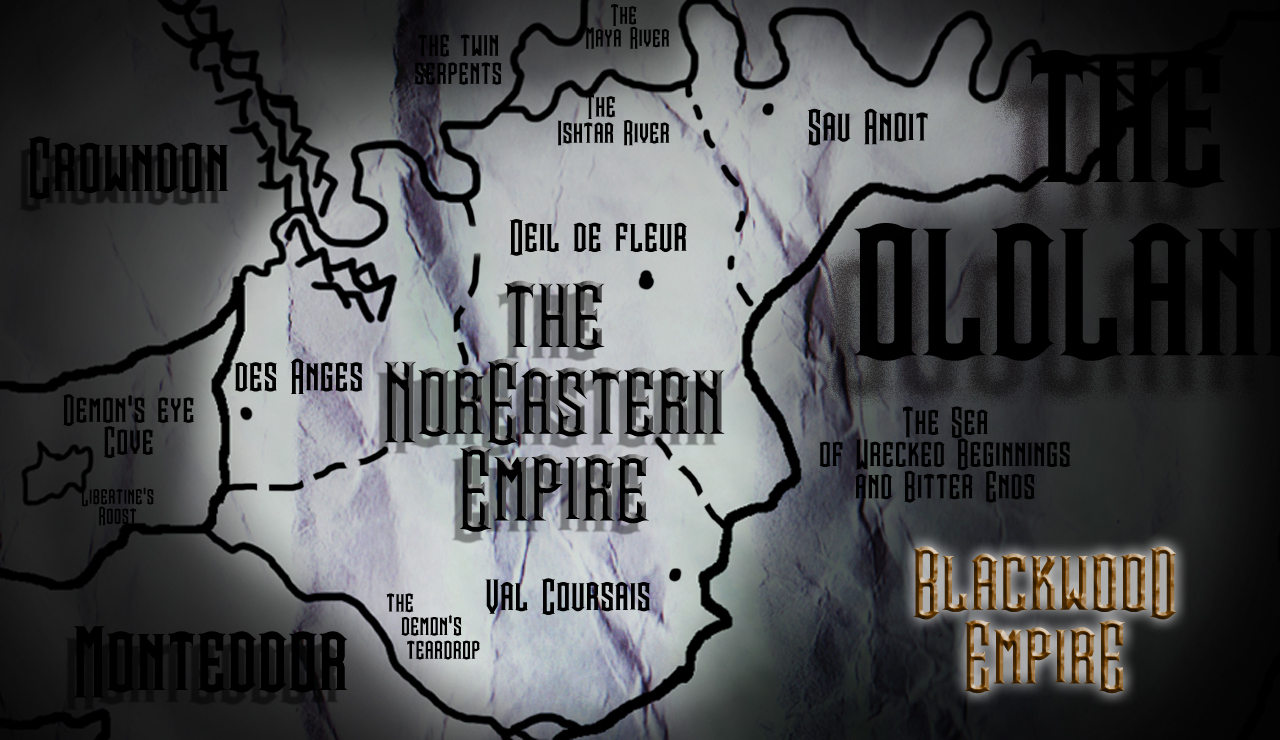
According to many, the NorEastern Empire is the cultural center of the world at the time of the Blackwood Empire. It is roughly the same size in terms of landmass and population as Crowndon. And while Crowndon, as an Empire, is nearly three hundred years older than NorEaster, the civilizations of the NorEastern Empire are some of the oldest and long lasting.
It is made up of four nations, each with its own monarchy that retains relative autonomy: The Capitol nation of Oeil de Fleur in the center, Sau Anoit in the north east, des Anges in the south west, and Val Coursais in the south. Val Coursais is the largest of the four nations, and the most active in terms of political upheaval, but it is largely kept in check by the fact that it has the unfortunate claim to sharing a border with the Monteddorian Empire, a no doubt taxing situation that prevents the country from forming any real designs of seizing Imperial Authority.
The NorEastern Empire was the epicenter of the Alchemical Rift three thousand years before. Little physical evidence of this ancient civilization remains, except for the Capital of Oeil de Fleur, which remained largely intact after the fabled cataclysm.
De Fleur remains the epicenter for much of the cultural activity in the Empire today, and for much of the Triumvirate as well. Students from Crowndon, Monteddor, and even the continent of Sarnwain flock to Oeil de Fleur for education and leisure.
All of this culture and learning is not without a dark side, of course. The NorEastern Empire likes to boast an atmosphere of inclusiveness and progressive thinking. But there always seems to be some hothead who doesn’t feel included enough. It seems as though every hundred years or so some new philosophy crops up that leads to cultural upheaval. Fortunately, these rarely escalate into full blown revolution, and typically sort themselves out. Many NorEasterners cite this as a positive. “Come for the cultural unrest,” they say. “Stay for the refreshments afterwards.”
At the time of Blackwood Empire, the practice of Alchemy has seen a resurgence. Once feared for being the cause of the so-named Alchemical Rift, time and humanity’s resilience to lessons learned have lead to curious minds exploring the ancient practice, and the founding of the Academic Alliance of Alchemists and Alliterators. However, much of what was known of the alchemical process has been lost, and with few exceptions, the practice of Alchemy is viewed in modern times as a cheap parlor trick, which has perhaps only fueled the idea that it is not so dangerous after all.
The discovery of the Blackwood Grove and the recent study showing that it will be depleted in a century’s time has also increased interest in Alchemy, seeing as how Blackwood does not occur naturally and must be created using a complex formula nobody remembers. Thousands of young Alchemists dream of unlocking the secret and the glory that would come with it while sipping tea and trading alliterations with each other.
Militarily speaking, the NorEast Empire is nothing to write home about, yet they recently defeated Crowndon in a decade long war. How did an empire full of artisans and philosophers who like to write about injustice more than act against it manage to defeat the world’s foremost military power, you ask? Largely by being completely unaware of how to fight a war, to be perfectly honest.
Crowndon went into the war expecting a straightforward fight. They lined up their armies on the battlefield and expected the NorEast to meet them as gentlemen. Their philosophy: straight ahead. The NorEast, by contrast, went in every other direction. They employed subterfuge and propaganda, misdirection and sabotage. They bolstered their ground forces with mercenaries from Monteddor and Sarnwain. They fought dirty, something unexpected from a people thought to be cultured and honorable. They also had Rigel Rinkenbach, who designed and oversaw the construction of the air-planes that devastated the Crowndon Air Corps. over the Divide.
Some say they even had aid from the Ephemeral Cartographers, though no evidence of this exists. There are also rumors that the NorEasterners employed reactivated machines from the Old Order, though no evidence of this exists either, aside from accounts from the battlefield, mostly from Crowndon officers who had a lot to lose by copping defeat to, quote, “Word-slingers and pornographers.”
Economically speaking, exports include fine wines, sugar, olive oil, wheat, and various fruits and vegetables. The NorEastern Empire also creates most of the world’s art, including music, theatre, and sculpture. They are also the foremost purveyors of adult entertainment, including brothels in most major cities and the publishing of penny dreadfuls.
Notable citizens include: Sir Rigel Rinkenbach, Pixie Sinclaire, Violet and Arufina Villanova, and Anson Blakely.
Notable Organizations include: The NorEastern Subterfuge Society (N.E.S.S.), and the Academic Alliance of Alchemists and Alliterators.
I thought I’d try something different for today’s post and present a bit of geo-political backstory for Blackwood Empire. This is all still very early in development and subject to change of course, but I figure it might be of interest to my fellow world builders out there, as well as provide context for some of the stories I’ll be writing. Constructive feedback is welcome.Continue reading “The World of Blackwood Empire: A Brief History of Crowndon”→
It was my hope to have a video to post this week, but YouTube being YouTube, it uploads to around 92% and then stops, so I need to figure that out. And besides, I should probably make a few tweaks to it before showing it anyway.
In the meantime, I thought I’d share a project I’m working on that’s in the very rough stages of development. It’s meant to be my final for my “Organic Modeling and Hard Surface Texturing” class, due next week. Normally, I wouldn’t post something this early, but what the hell. Maybe some 3DS Max guru will see it, see how jacked up my poly-flow is, and give me some pointers.
The NorEastern Empire spent much of its six year war against Crowndon getting its posterior kicked. Though masters of subterfuge and intelligence gathering, the NorEastern empire had neither the resources nor the military prowess to endure a long standing war, and by the time of the battle of the Divide, they were all but broken.
Today’s post is an excerpt from the novella “Where, No One Knows”, which I wrote for NaNoWriMo last year. In it, Pixie Sinclaire is tasked with infiltrating Where, No One Knows, a floating prison made out of three enormous interconnected ironclad warships. Her task: find and extract her former lover, Rigel Rinkenbach, before he unlocks the secret to creating Blackwood and gives it to the NorEastern Empire’s enemies.
Things don’t go as planned, however. For no sooner than Pixie arrives on the ship does a woman named Dougherty lead a mutiny, throwing the ship into chaos. She also wants Rinkenbach, for very different reasons. Pixie and Dougherty forge a fragile alliance, and come up with a plan to get Pixie onto the command ship where Rinkenbach is being held.
Arufina Villanova is a member of a society of assassins known as the Scarlett Circle, an organization trumped in mystery and cloak-and-dagger-ness by only the Ephemeral Cartographers. Her older sister was a Cartographer before the war, and Aru might have been as well. Something else happened, however, and Arufina’s sister disappeared, putting Arufina on the run.
 First up, an updated image of my proposed cover art for Where, No One Knows. Still a bit rough around the edges, but I’m liking it so far. It’s a combo of digital art made in Photoshop and 3D models created in 3DS Max. I’m still figuring out what type-face I want to use and text placement, so any input that may be had is appreciated.


 Blackwood Empire
